Increasing flexibility of fixed-term employment contracts and other changes to the Employment Contracts Act
The Government is reforming the legislation on working life to remove barriers to employment and, in particular, to strengthen the operating conditions of SMEs. Barriers to employment will be lowered by e.g. increasing flexibility of the conditions of fixed-term employment contracts and by changing the duration of the notice period for layoffs and the employer’s re-employment obligation.
Questions and answers on changes to the grounds for fixed-term employment, the notice period for layoffs and the re-employment obligation
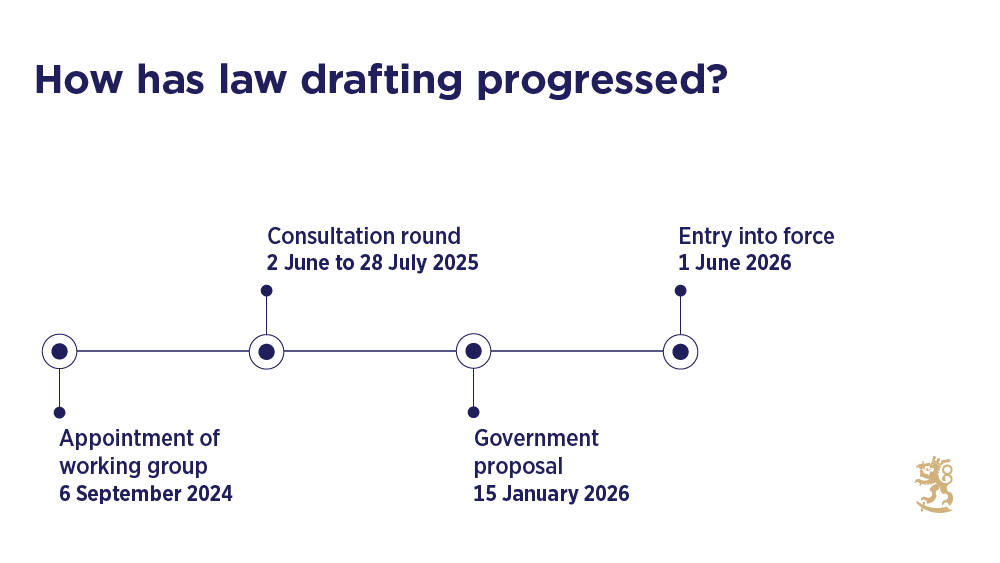
The information given on this page is based on the Government proposal submitted to Parliament on 15 January 2026.
The aim is to remove barriers to hiring employees and to improve the operating environment, especially for small and medium-sized companies.
Currently, a fixed-term employment contract may be concluded on the employer’s initiative for a justified reason. In addition, a fixed-term employment contract may be concluded without a justified reason with a long-term unemployed person.
In future, a fixed-term employment contract could be concluded without a justified reason in cases concerning the first employment contract between an employer and an employee. Moreover, such a contract could be concluded if the employee had worked for the same employer previously but the employment relationship had ended more than two years ago.
A fixed-term contract could be concluded for a maximum of one year without a justified reason.
The contract could be renewed up to two times during the year following the conclusion of the first fixed-term employment contract. In total, a maximum of three fixed-term employment contracts could be concluded without a justified reason. The combined total duration of the contracts could not, however, exceed one year.
For example: Three fixed-term employment contracts without a justified reason. The total maximum duration does not exceed one year. Renewals have been made within one year of the beginning of the first employment contract: employment contract from 1 January 2026 to 30 June 2026, employment contract from 1 August 2026 to 31 October 2026, employment contract 31 from December 2026 to 31 March 2027.
At the end of the fixed-term employment contract, the employer would be required to give the employee a reasoned explanation of the possibility to hire the employee for an employment relationship of indefinite duration or for a fixed-term employment relationship concluded for a justified reason.
The employer would also be required to offer the employee work in cases where a fixed-term employment contract concluded without a justified reason was about to end and the employer was considering hiring more employees for the task in question or a similar task. After termination of the employment contract, the obligation to offer work would last for a period corresponding to one third of the total duration of the employment contracts concluded with the employee. The period could not exceed four months.
The obligations of the employer aim to prevent possible abuses of fixed-term contracts concluded without a justified reason.
A fixed-term employment contract concluded in violation of the proposed regulation would be considered to be valid until further notice.
Concluding or not concluding a fixed-term employment contract on discriminatory grounds would not be allowed, as is the case at present.
The proposal is not estimated to have a particular effect on any sector dominated by men or women.
Moreover, the amendments proposed by the Government are not in themselves estimated to weaken the protections against discrimination. However, a possible increase in the number of fixed-term employment contracts may also affect the number of suspected discrimination cases related to them. The prohibition of discrimination laid down in the Act on Equality between Women and Men also applies to fixed-term employment contracts without a justified reason concluded under the new regulation. Under the Act, the action of an employer is considered to constitute discrimination if the employer, when deciding on the
duration or continuation of an employment relationship, acts in a way that the employee finds themself in a less favourable position on the basis of pregnancy, childbirth or family leave.
The awareness of employers concerning the statutory prohibition of discrimination would be increased by a new provision under which concluding or not concluding a fixed-term employment contract on discriminatory grounds would not be allowed.
The employee and the employer would have the right to terminate a fixed-term employment contract concluded without a justified reason that has lasted for at least six months. This would increase flexibility for both employers and employees. For example, an employee could resign before the end of a fixed-term contract concluded without a justified reason if the employee was offered an employment contract for an indefinite term elsewhere.
That is the period of notice given to an employee before a lay-off. The purpose of the notice period is to give employees the opportunity to prepare for interruptions in work and pay.
Under the previous Act, the employer was required to give an employee a personal notice of lay-off no later than 14 days before the lay-off begins. In addition, collective agreements may specify a notice period of 14 days in accordance with the Act or longer.
The notice period would be shortened to seven days. The possibility of local collective bargaining would also be added to the Act. The employer and the representative of the employees could agree to observe the seven-day notice period instead of the longer notice period included in the collective agreement. The agreement must be in writing.
The re-employment obligation refers to a situation where an employer needs employees for the same or similar tasks for which the employer has dismissed an employee four months earlier for financial or production-related reasons. If the dismissed employee is a jobseeker, the employer is required to offer the employee the work in question. However, the obligation to re-employ would be six months for employment relationships that have lasted at least 12 years.
Re-employment obligation would only apply to employers with at least 50 employees.
It would be possible to agree on different rules on the re-employment obligation in the collective agreement, as is currently the case.
Fixed-term employment contracts are regulated by e.g. the EU Fixed-term Work Directive (the so-called Framework Agreement on fixed-term work). The Framework Agreement requires Member States to prevent the abuse of fixed-term employment contracts. Member States may choose different ways to do this. The agreement does not require Member States to regulate the first fixed-term employment contract with an employee.
There are no binding international agreements or EU regulations on the re-employment obligation and the period of notice for lay-offs.
To the extent that legislation aims to authorise derogations from collective agreements offering better protections with the means of local collective bargaining, the regulation must consider international agreements on the freedom of organisation and the right to collective bargaining (e.g. ILO) and the provisions of the Constitution safeguarding these rights.
The reform is expected to lower the threshold for employers to hire employees, to increase legal certainty and to reduce the administrative burden to some extent.
The change is expected to increase the use of fixed-term employment relationships.
Relevant research data does not indicate that the reform would have a clear impact on employment or unemployment.
The Ministry of Economic Affairs and Employment would monitor the general effects of the amendments to the Act. The key elements to be monitored include changes in the number of fixed-term employment relationships and the effects of such changes on working life, for example the realisation of employment protection and possible gender-based impacts. Because the effects will not become visible right away, it would be reasonable to assess them three years after the Act has entered into force, at the earliest.
On 6 September 2024, the Ministry of Economic Affairs and Employment appointed a tripartite working group to prepare the legislative amendments in accordance with the Government Programme. The tripartite working group that prepared the legislative amendments was not unanimous. Dissenting opinions were submitted by the Confederation of Finnish Industries EK and the Local Government and County Employers KT, the Federation of Finnish Enterprises as well as the employee confederations the Central Organisation of Finnish Trade Unions SAK, the Confederation of Unions for Professional and Managerial Staff in Finland Akava and the Finnish Confederation of Professionals STTK.
The Ministry of Economic Affairs and Employment organised a consultation round on the working group’s report between 2 June–28 July 2025.
According to the government proposal, the legislative amendments would enter into force on 1 April 2026.
Current issues
Government proposes more flexibility for fixed-term employment contracts
Consultation round begins on changes to fixed-term employment contracts, notice period of layoffs and re-employment obligation
Tripartite working groups to draft legislative proposals on removing barriers to employing workers
Katariina Jämsén, Senior Specialist
Ministry of Economic Affairs and Employment, Employment and Well-Functioning Markets Department, Labour Market, Työelämän sääntely TYS Telephone:0295047143 Email Address: [email protected]