Amendments to the Act on Co-operation within Undertakings
The Government aims to reform working life legislation to remove barriers to employment and, in particular, to strengthen the operating conditions of small and medium-sized companies. The amendments to the Co-operation Act are among the Government’s labour market reforms. The aim is to reduce the administrative burden caused by legislation, especially in companies with fewer than 50 employees.
The first phase of the legislative project implemented the Government Programme’s entries on raising the threshold for applying the Co-operation Act and reducing the minimum duration of change negotiations by half. The second phase of the legislative project will include amendments to board‑level employee representation.
Questions and answers on the amendments to the Co-operation Act
Amending the Act on Co-operation within Undertakings (hereinafter, the Co-operation Act) is one of the Government’s labour market reforms that will remove barriers to employment and strengthen the operating conditions of small and medium-sized companies, in particular. The Government aims to reduce the administrative burden caused by the application of the Co-operation Act, especially in companies with fewer than 50 employees. In addition, the reform will speed up the ability of all companies to react to changes in the operating environment.
Until now, the Co-operation Act has applied to companies, corporations and branches that regularly employ at least 20 people. From 1 July 2025, the Co-operation Act will primarily apply to companies, corporations and branches that regularly employ at least 50 employees. However, the Act will lay down certain obligations for employers that regularly employ 20−49 people (see questions on continuous dialogue and the obligation to hold change negotiations).
Moreover, the rules on the transfer, merger and division of business will continue to apply to all companies, corporations and branches that regularly employ at least 20 people.
In future, the rules on board-level employee representation would apply to companies with at least 100 employees. At present, the Act applies to companies with at least 150 employees.
The purpose of continuous dialogue is to promote the handling of matters between the employer and employees.
Beginning on 1 July 2025, continuous dialogue between the employer and employees will be lightened in companies and corporations that regularly employ 20−49 people. The employer must create workplace-specific practices for regular continuous dialogue. Existing practices may also enable continuous dialogue to take place. The employer will engage in a dialogue with the representative of the employees unless the employer and the representative agree that the dialogue will be conducted with the employees as a whole. If the employees do not have a representative, the employer will engage in a dialogue with the employees.
Introducing this lighter procedure is based on the amount of administrative burden that continuous dialogue can cause, especially in small and medium-sized companies.
From 1 July 2025, a company or corporation regularly employing fewer than 50 employees no longer has an obligation under the Co-operation Act to conduct change negotiations in accordance with the Act concerning significant changes to the position of one or more employees, which are being considered by the employer and fall within the scope of the employer’s power of management (so-called light change negotiations, where the aim is not to reduce the use of labour).
Employers that regularly employ 20–49 persons in employment relationship must initiate change negotiations in situations where the employer is considering measures to reduce the use of labour affecting at least 20 employees over a 90−day period, i.e. termination, lay-off, reduction to part-time employment or unilateral modification of an essential term in the employment contract for financial or production-related grounds. However, any lay-offs considered by the employer that are based on a temporary reduction of work or the employer’s ability to offer work (lay-offs lasting a maximum of 90 days) will not require change negotiations.
The Co-operation Act lays down provisions on the duration of change negotiations concerning the reduction of workforce. Under the current Act, change negotiations last at least six weeks or 14 days, depending on their subject.
From 1 July 2025, the duration of change negotiations will be cut by half. The amendment will apply to all companies, corporations and branches within the scope of application of the Act. The minimum duration of the change negotiations will be either three weeks or seven days, depending on the matters to be negotiated and the number of employees at the company or corporation.
As of 1 July 2025, a provision will be added to the Act concerning the time reserved for determining the availability of employment services. The provision will be applied if the employer submits a proposal for negotiations concerning its plan to terminate at least ten employees on production-related and financial reasons. The employment contract of a terminated employee may not end before 30 days have elapsed from the date a proposal for negotiations was submitted to the employment authority. The proposal for negotiations will be submitted to the authority at the beginning of the negotiations.
The purpose of this provision is to reserve sufficient time for the employment authority to determine, together with the employer, the employment services available for the affected employees to support their employment.
The amendments to the Co-operation Act have been prepared by a tripartite working group with representatives from the Central Organisation of Finnish Trade Unions SAK, the Confederation of Unions for Professional and Managerial Staff in Finland Akava, the Finnish Confederation of Professionals STTK, the Confederation of Finnish Industries EK and the Federation of Finnish Enterprises, in addition to the Ministry of Economic Affairs and Employment.
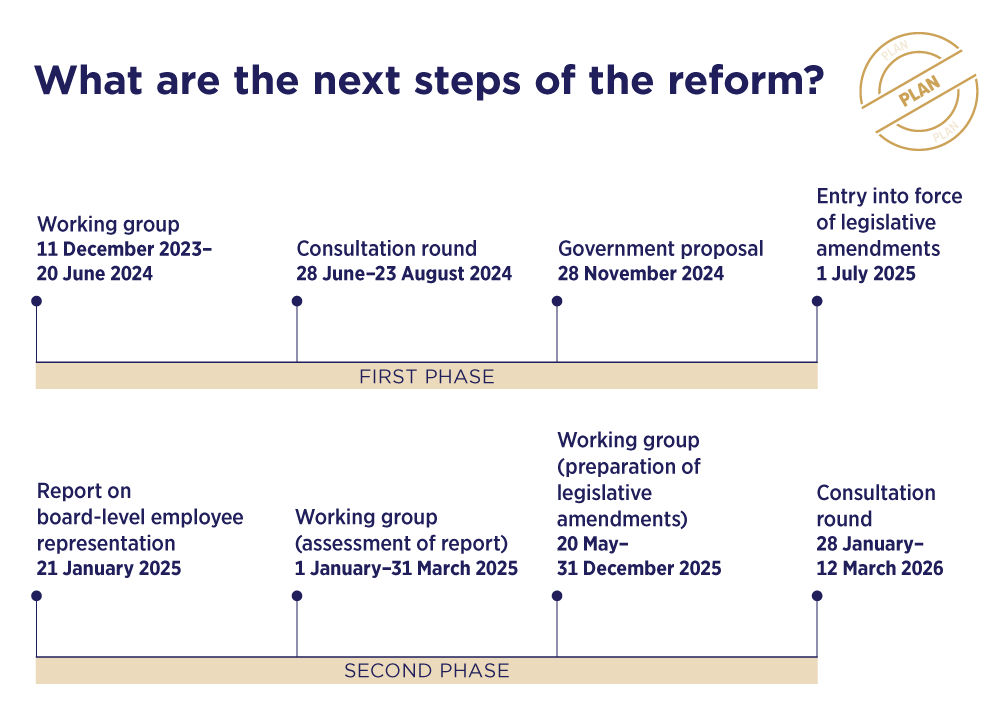
A tripartite working group discussed the matters related to the scope of application and the duration of the change negotiations during its first term of office on 11 December 2023–20 June 2024. The working group’s task was to prepare a report in the form of a government proposal. The working group was not unanimous in its work. The employee organisations together, the Confederation of Finnish Industries EK, and the Federation of Finnish Enterprises gave a dissenting opinion. The working group’s report was circulated for comments from 28 June to 23 August 2024.
The amendments on raising the application threshold and shortening the duration of change negotiations entered into force on 1 July 2025.
Board-level employee representation refers to the representation of personnel in the company’s administration, for example in the board of directors or senior management group. At present, the rules on board-level employee representation apply to companies with at least 150 employees. However, it is not mandatory even in the companies to which the rules apply. According to the current rules, board‑level employee representation must be introduced if at least two personnel groups request it.
The Government Programme states that the possible needs to amend the Co-operation Act, which was revised in 2022, concerning e.g. the board-level representation of employees will be assessed in the mid-term policy review session.
A report on the possible need to make amendments to board-level employee representation was submitted by rapporteur Jukka Ahtela (Master of Laws, Trained on the Bench) to Minister of Employment Arto Satonen on 21 January 2025. The report was subsequently discussed by a tripartite working group, whose term of office ran from 1 January to 31 March 2025.
In its mid-term policy review session in spring 2025, the Government decided to lower the scope of application of board-level representation of employees from 150 to 100 employees. It also stated that board-level employee representation must take place in the board of directors or senior management group. A tripartite working group was appointed to prepare the changes. The working group’s report is circulated for comments from 28 January to 12 March 2026.
The working group’s report proposes these amendments:
- The rules on board-level employee representation would be extended to companies and corporations with at least 100 employees.
- A board of directors, senior management group or comparable decision-making body would need to have board-level employee representation. The current system based on representation agreements would end.
- If the majority of employees, either through a representative or by other means, requested board‑level employee representation, they would have the right to have it implemented. Implementation would no longer depend on a request from a majority of two personnel groups.
The purpose of revising the rules on board‑level employee representation is to strengthen employees’ opportunities to take part in the employer’s decision‑making and in the handling of matters that concern their position.
The amendments to the Co-operation Act have been prepared by a tripartite working group with representatives from the Central Organisation of Finnish Trade Unions SAK, the Confederation of Unions for Professional and Managerial Staff in Finland Akava, the Finnish Confederation of Professionals STTK, the Confederation of Finnish Industries EK and the Federation of Finnish Enterprises, in addition to the Ministry of Economic Affairs and Employment.
The second term of the working group was from 1 January 2025 to 31 March 2025. During that term, the working group discussed a report on the need to amend board-level employee representation.
The Government made the decisions on board-level employee representation in its mid-term policy review session. The Ministry of Economic Affairs and Employment then appointed a tripartite working group on 20 May 2025 to prepare the related measures. The working group has representatives from the Confederation of Finnish Industries, Service Sector Employers, Federation of Finnish Enterprises, Central Organisation of Finnish Trade Unions, Finnish Confederation of Professionals, and Confederation of Unions for Professional and Managerial Staff in Finland. The working group did not reach a unanimous position; the representatives of some labour market organisations submitted dissenting opinions to the group’s report. The Ministry will circulate the working group’s report for comments from 28 January to 12 March 2026.
The Government aims to submit the proposal on amending board‑level employee representation in spring 2026. The amendments are intended to enter into force on 1 July 2026.
News
Legislative amendments on board‑level employee representation and carried‑over holiday sent out for comments
Legislative amendments enter into force: higher threshold for applying the Co-operation Act and shorter duration of change negotiations
Government to reduce administrative burden on small companies – changes to Co-operation Act to take effect on 1 July 2025
Tripartite working groups to prepare the Government’s labour market reforms outlined in the mid-term policy review session
Working group’s paper on the report on board-level employee representation has been completed
Contact information
Nico Steiner, Senior Ministerial Adviser
Ministry of Economic Affairs and Employment, Employment and Well-Functioning Markets Department, Labour Market, Työelämän sääntely TYS Telephone:0295049001 Email Address: [email protected]