Finnish and Estonian ministers discuss future energy cooperation
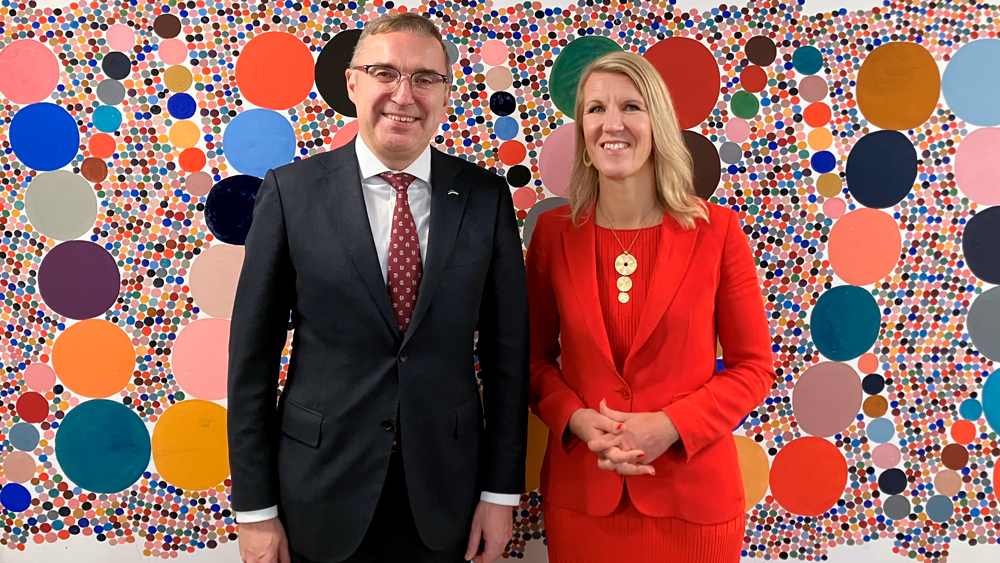
Minister of Climate and the Environment Sari Multala and Estonia’s Minister of Energy and the Environment Anders Sutt discussed future opportunities for Finnish-Estonian energy cooperation in Helsinki on 18 December 2025. The countries have so far had successful collaboration on developing the transmission networks for electricity and gas, protecting critical infrastructure and creating a common electricity market.
Finland emphasised in the EU energy ministers’ meeting that Projects of Common Interest (PCI) must be prioritised similarly to the Energy Highways Initiatives, which were highlighted by the European Commission in its Grid Package initiative to upgrade electricity grids.
Multala and Sutt also discussed efforts to influence the content of the Connecting Europe Facility (CEF), which is currently under preparation by the EU. During the CEF negotiations, Finland has stressed that common EU funding should not be used for internal energy infrastructure of Member States; instead, it should be allocated exclusively for cross-border projects between Member States.
In their meeting on Monday, EU energy ministers reached a partial general approach on the CEF Regulation. Finland and Estonia consider it important and topical that protecting critical infrastructure is now included in the Regulation. The aim is that improving and repairing critical submarine infrastructure will be funded by the EU in future.
“It is untenable that no EU funding instruments for such purposes exist at the moment and that any repairs to submarine infrastructure are currently paid by the Member States alone. For example, Finland and Estonia mostly carried the costs for fixing the cable and pipeline damages in 2023 and 2024,” Minister Sari Multala said.
The countries will continue to develop the power transmission network. Alongside the two Estlink transmission connections, the Finnish and Estonian main grid operators are currently engaged in Estlink3 project that will be designated as a PCI and as such be eligible for EU funding.
The ministers also discussed the future of nuclear power. Finland is particularly interested in Estonia’s plans to build nuclear energy in the future, especially small modular reactors (SMRs).
Since the 1970s, nuclear power has been an important, reliable and safe form of energy production in Finland. The Programme of Prime Minister Petteri Orpo’s Government states that Finland needs more nuclear power. The Government is advancing this objective e.g. by reforming the Nuclear Energy Act, which will facilitate the construction of SMRs.
”We are confident that Estonia will be able to follow in these footsteps as long as they remain politically committed in the long term and determined in implementing the measures in practice. Finnish companies have skills and knowledge that Estonia could make use of if it decides to build SMRs for electricity or heat generation,” Multala adds.
In connection with the meeting, the ministers also discussed energy security.
Inquiries:
Riku Huttunen, Director General, Ministry of Employment and the Economy, tel. +358 50 431 6518
Elina Johansson, Ministerial Adviser, Ministry of Economic Affairs and Employment, tel. +358 50 301 4607
Lyydia Ylönen, Special Adviser to Minister of Climate and the Environment, tel. +358 50 476 1341