Working Life Barometer: Wage-earners have cautiously positive view of AI use at work
Close to half of wage-earners in workplaces that use artificial intelligence (AI) responded that AI has increased the efficiency of their work. Meanwhile, one third of them estimate that AI has improved the quality of their work.
Working Life Barometer is a survey published annually by the Ministry of Economic Affairs and Employment which describes the quality of working life of wage-earners. The autumn 2025 survey took a more in-depth look at AI usage. The results can be applied more generally to wage-earners across Finland.
Experience with AI varies between sectors
Of the wage-earners surveyed, 45 per cent said AI technology was used at their workplace. AI is prevalent especially at the largest workplaces: 70 per cent of respondents working in organisations with at least 200 people stated that AI was being used at their workplace.
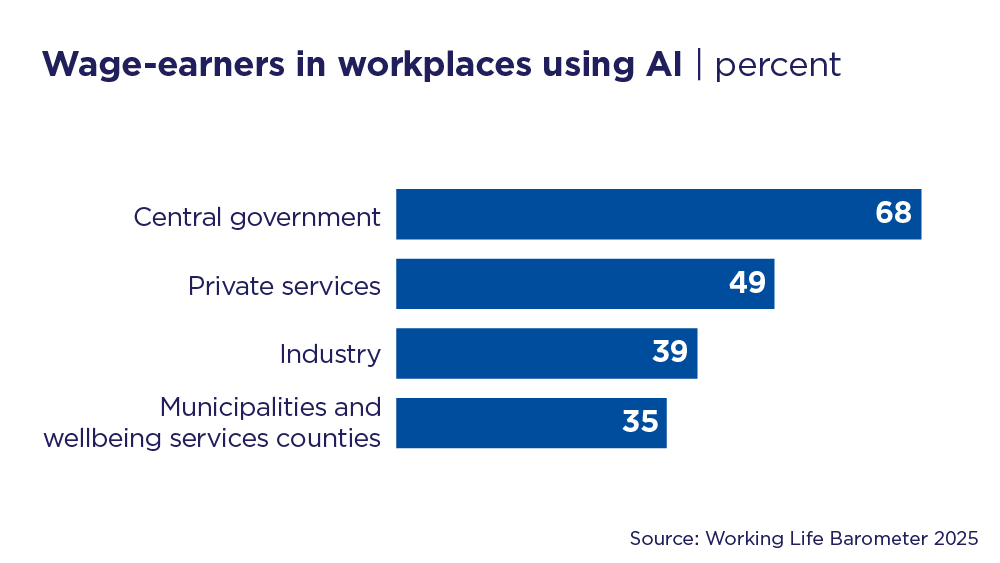
The use of AI was most common in central government (68 per cent) and private services (49 per cent). Within industry, municipalities and wellbeing services counties, AI use was reported by slightly more than a third of employees.
Wage-earners whose workplaces use artificial intelligence were asked to evaluate its effects.
- Of the respondents, 18 per cent stated that AI had eliminated work tasks. On the other hand, around 40 per cent reported that the use of AI had created new tasks.
- In addition, 45 per cent of respondents estimated that AI had made their work more efficient, while 52 per cent said AI had no impact on it.
- One third of those surveyed found that AI had improved the quality of their work, in contrast to 64 per cent who saw no such effect.
Respondents at workplaces where AI is used and who themselves utilise digital applications at work were asked about the frequency of AI use. Around one-fifth of them used AI daily and close to 30 per cent used it weekly. More than a third of all wage-earners using information technology said they needed training to use AI at work. Nearly a half of senior white-collar employees and of those aged 45 to 54 were in need of training.
Work atmosphere remains good but labour market uncertainty on the rise
Working Life Barometer has surveyed the quality of working life of wage-earners for more than 30 years. The results vary based on gender, professional status, sector and size of workplace.
In the long term, the development of a culture of continuous learning is a long-term positive trend at workplaces, but growth has levelled off lately. Participation in training offered by employers has fallen in recent years, while independent studies at work have become more popular. Compared to all wage-earners, participation in workplace training is considerably less common among blue collar workers, people employed in small workplaces and the oldest wage-earners.
Views on the labour market have turned less optimistic in the past few years. More people also reported feeling mental strain due to work. In 2025, nearly two out of three wage-earners felt that their work was mentally strenuous at least to some extent. These experiences were more frequent among women, people aged 35 to 44, white-collar employees and wage-earners in municipalities and wellbeing services counties.
Following a long-term trend, the atmosphere at workplaces continued to improve, however. In 2025, more than four out of five wage-earners felt that their workplaces had an atmosphere of trust, where information was communicated openly, employees were treated equally and conflicts could be resolved. Men gave a higher rating of workplace atmosphere than women.
Inquiries:
Maija Lyly-Yrjänäinen, Chief Specialist, Ministry of Economic Affairs and Employment, tel. +358 295 047 297