EU leaders call on Russia to cease aggression against Ukraine immediately
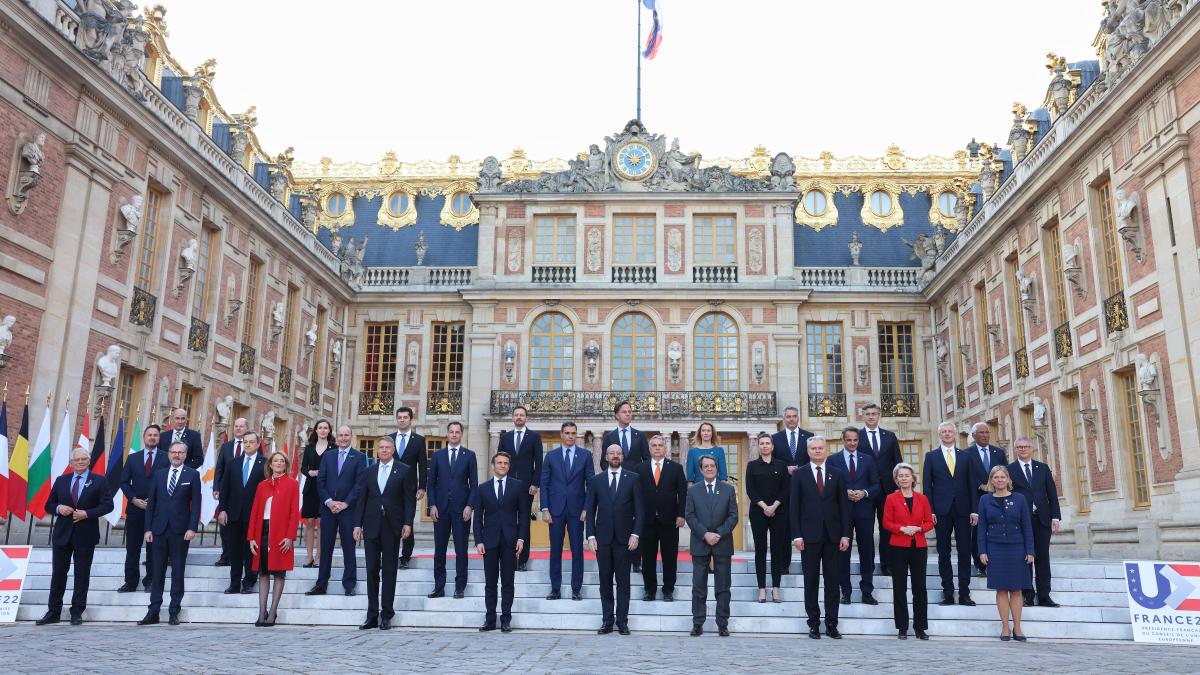
At their informal meeting in Versailles, France, on 10 and 11 March, the EU heads of state or government strongly condemned the attack launched by Russia on Ukraine two weeks ago and demanded that Russia withdraw its troops from the country immediately and unconditionally. The leaders also adopted the Versailles Declaration, which seeks to bolster the Union’s defence capabilities and develop its economic base.
The leaders of the EU Member States want to offer temporary protection to all war refugees from Ukraine, and will continue to show solidarity and to provide support and humanitarian assistance when receiving them. The EU will continue its wide-ranging support to Ukraine.
The EU has responded swiftly to Ukraine’s application for EU membership and, in accordance with the relevant provisions of the Treaties, the Council has invited the Commission to submit its opinion on the application. Without delay, the EU will further strengthen its bonds and deepen its partnership to support Ukraine in pursuing its European path. The EU leaders stress that Ukraine belongs to the European family. The Council has also invited the Commission to submit its opinions on the applications of the Republic of Moldova and Georgia.
The Versailles Declaration calls on Russia to fully abide by its obligations under international humanitarian law. The EU leaders stress that Russia bears full responsibility for this war. They are ready to move quickly with further sanctions against Russia and its accomplice Belarus. Those responsible will be held to account for their war crimes, including the indiscriminate targeting of civilians. In this respect, the EU leaders welcome the decision of the prosecutor of the International Criminal Court to open an investigation into the matter. The EU leaders call for the safety and security of Ukraine’s nuclear facilities to be ensured immediately with the help of the International Atomic Energy Agency (IAEA).
“The effects of the strong sanctions can already be seen. The EU Member states are ready to respond to developments in the situation swiftly, strongly and as a united front,” said Prime Minister Sanna Marin.
“We will continue to provide extensive support to Ukraine in a variety of ways. It is important to help those fleeing the war, and Finland wants to shoulder its share of responsibility. Together, the EU Member States are also supporting countries seeing a major influx of refugees. One way to do so is for other Member States to receive refugees,” Prime Minister Marin continued.
The Versailles Declaration states that in light of growing instability, strategic competition and security threats, the EU will take on more responsibility for European security. The EU will also reduce its dependency on Russian energy and build up a more robust economic base.
The Declaration states that EU-NATO cooperation and a stronger and more capable EU in the field of security and defence are key to overall security. The Declaration highlights means to improve the EU’s security and defence capabilities and reaffirms that the EU will adopt the Strategic Compass.
The Declaration notes that a stronger and more capable EU will contribute positively to global and transatlantic security and is complementary to NATO, and recalls that NATO remains the foundation of collective defence for its members. The solidarity between Member States is reflected in Article 42(7) of the Treaty on European Union. More broadly, the EU reaffirms its intention to intensify support for the global rules-based order, with the United Nations at its core. The EU will ramp up its investments and improve its resilience to cyber threats.
With regard to energy, the EU will gradually phase out its dependency on Russian gas, oil and coal. Means to achieve this will include accelerating the reduction of the Union’s overall reliance on fossil fuels and diversifying energy supplies and routes, including through the use of liquefied natural gas and the development of biogas.
The EU will build a more robust economic base by strengthening the single market, reducing excessive dependency on imports and fostering key industrial initiatives.
Inquiries: Jari Luoto, State Under-Secretary for European Affairs, tel. +358 50 468 5949, Lauri Voionmaa, Special Adviser (International Affairs), tel. +358 295 160 306, Tuulia Pitkänen, Special Adviser for EU Affairs, tel. +358 41 501 3092 and Anne Sjöholm, Head of Communications for EU and International Affairs, tel. +358 40 537 0733, Prime Minister’s Office